
Desk Lamps vs. Overhead Lighting: Which Is Better for Your Home Office?
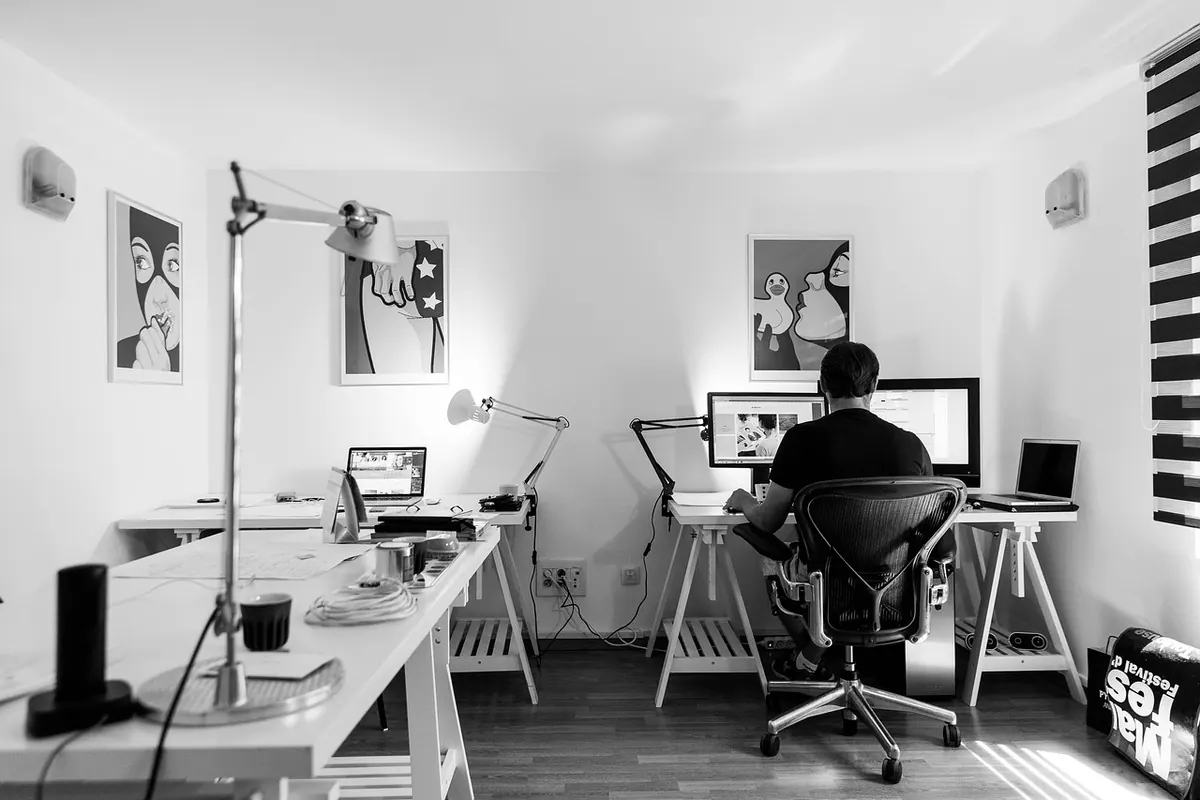
Most home offices are lit by accident. You inherit a ceiling pendant from the previous owner, put the desk against the nearest wall, and get on with your day. That works perfectly well until the afternoon arrives and your eyes feel gritty, or you notice you've been leaning closer to the screen for the past hour. The answer is rarely simply "more light". It's about where the light comes from, what it lands on, and how much of it your screen throws back at you.
Direction matters more than brightness
Two desks can measure the same brightness and feel completely different to sit at. The difference is direction. Your eyes adapt to whatever is brightest in your field of view: if that's a ceiling fitting reflected in a glossy monitor, the rest of the room will feel dim by comparison and you'll strain to read anything else. If the brightest thing is a pale wall behind the screen, your eyes relax and everything else looks properly lit.
That single fact explains most of the desk lamp versus overhead light argument. Neither is simply better. Each one solves a different problem.
What a desk lamp gets right
A task lamp gives you something a ceiling light cannot: control. You decide which square of desk it falls on, how strong it is, and which way the shadows fall. Placed to the side of your work — generally the opposite side from your writing hand — it lights the page without your arm blocking it, and it stays out of your direct line of sight.
It's also the quickest way to fix a specific complaint. Reflections in the screen, dark notes under your hand, a face that looks unlit on video calls: all three are usually solved by a light you can aim rather than by the fixture on the ceiling. Because you're lighting a small area, a modest lamp uses very little electricity too, though running costs are rarely the thing worth optimising here.
Where a desk lamp goes wrong
- Placed in front of the monitor, so you're looking past it at the screen — or seeing it mirrored in the glass.
- Set far brighter than the rest of the room, so your eyes readjust every time you glance up.
- A bare bulb or shallow shade at eye level, producing glare instead of useful light.
- Angled at the screen rather than the desk. Aim light at paper and keyboard, never at the display.
- Used as the only light in a dark room, which feels cosy for five minutes and uncomfortable for an hour.
What overhead lighting gets right
Ceiling and wall lighting does the job lamps can't: it lights the room as a whole. Walls, floor, shelves and doorway all sit at similar levels, so your eyes aren't constantly adapting between a bright desk and a dark corner. That evenness matters more than people expect, especially if you look up often — at a second monitor, a whiteboard, or a colleague on a call.
It's also the practical choice for everything that isn't desk work. Walking to the printer, sorting a drawer, tidying up at the end of the day: all easier under general light. An uplighter or a ceiling fitting with a diffuser spreads that light without a bright spot in your eyeline, which is far kinder than a bare pendant directly above your head.
Where overhead lighting falls short
A single ceiling light above the desk throws shadows straight down. Your own head and hands become the obstruction, and the page you're reading sits in the dimmest part of the pattern. It's fixed, so you can't shift it when the glare starts to annoy you, and it lights the top of your monitor while leaving the notebook beside it dull. For close, detailed work, it's a blunt instrument.
Which is better for eye strain?
It depends on what's causing the strain. If your screen is reflecting a window or a ceiling light, a better lamp won't help much — you need to move the screen or block the reflection. If your only light is a pool on the desk and the rest of the room is dark, adding ambient light will do more for comfort than a brighter lamp.
The general principle is to keep the differences modest. Aim for the area around your screen to be reasonably close in brightness to the screen itself, with the task light a little brighter than its surroundings. Extreme contrast is what tires eyes, not any particular type of fitting. Take breaks, look across the room now and then, and remember that most people blink less when they're staring at a screen.
Colour temperature matters as well. Cooler light suits detailed work and mornings; warmer light feels calmer in the evening. Keep the lamp and the ambient light in the same family, or the room will feel unsettled.
On health: if eye strain, headaches or blurred vision persist despite better lighting, see an optician or your GP. Lighting is one factor among several, including your prescription and how your screen is positioned.
A two-layer set-up that suits most rooms
- Start with ambient light. Switch on the main light; if it's harsh, fit a softer bulb or add a floor uplighter aimed at the ceiling. You want the room to feel evenly lit, not bright.
- Fix the screen first. Move the monitor so no window, bulb or lamp is visible in it when it's switched off. Nothing else you do will matter as much.
- Add the task lamp last. Opposite side from your writing hand, shade at eye level or slightly below, tilted down onto the desk.
- Balance the two. If the lamp looks like a spotlight in a cave, raise the ambient light rather than dimming the lamp to nothing.
- Adjust through the day. Brighter and cooler in the morning, warmer and lower in the late afternoon. A dimmer or a lamp with two or three settings makes this a two-second job.
Choosing for your room
In a small box room with one window, a ceiling light plus a compact task lamp is usually the right combination: enough general light to stop the walls feeling like a tunnel, plus focused light where you're actually working. In a shared spare room, lean on the lamp so you can work early or late without lighting the whole space. North-facing rooms and dark winter mornings are where ambient light earns its keep. And if much of your day is spent on video calls, a lamp set just off to one side at roughly 45 degrees gives your face some shape; a light directly overhead does the opposite, shadowing your eyes and nose.
Try the cheap version first. Move your existing lamp, turn the ceiling light on or off, and notice how your eyes feel after an hour of real work. Most home offices need only one change — usually a lamp that's aimed properly, backed up by an overhead light soft enough to leave on.
Photo: tookapic / Pixabay